
 Finland
Insulation in Finland: Beat -30°C Winters with Save Cool Reflective Insulation
On 30 January 2026, the thermometer in Lappeenranta fell to -31.1°C and Vihti in western Uusimaa dropped to -29.3°C. The same morning, spot electricity prices jumped from about 20 cents to more than 40 cents per kilowatt-hour at peak hours (Yle News). For a Finnish household, that is the whole story of insulation in Finland in one morning: brutal cold, and an energy bill that punishes every watt that leaks out of the house.
This guide is for Finnish homeowners, cottage (mökki) owners, builders and importers. It explains what Finland’s building rules expect, where reflective insulation in Finland genuinely helps, and why the Save Cool bubble insulation range from Alumix is a smart layer to add to roofs, attics, walls and floors before the heating season gets serious.
Why Insulation in Finland Matters More Every Winter
Finland has one of the coldest inhabited climates in Europe. The Finnish Meteorological Institute regularly issues cold warnings for most of the country in deep winter, and Lapland can see -30°C to -35°C. Heating a house through months like that is expensive, and buildings are where much of the energy goes. According to Climateguide.fi, roughly 30% of the energy consumed in Finland is used by buildings, and heating buildings causes about 30% of the country’s greenhouse gas emissions.
For a homeowner this shows up in three ways:
- High heating bills. Heat escapes through the roof, the walls and the floor. With electricity spot prices able to double on a cold, windless day, every leak costs more.
- Cold surfaces and draughts. Poorly insulated attics, older log or timber-frame houses and unheated outbuildings feel cold even when the heating is on.
- Condensation and mould. Warm indoor air meeting a cold roof or wall creates moisture problems that damage structures over time.
What Finland’s Building Rules Expect
Finland has demanding energy rules. New buildings follow the Decree on the Energy Performance of New Buildings (1010/2017), and renovation work follows Ministry of the Environment decree 4/2013. The Ministry of the Environment states that energy efficiency must be improved when carrying out repairs and alterations, if this is technically, functionally and economically feasible.
The reference U-values for a heated new building are very low, for example about 0.09 W/(m²K) for a roof and 0.17 W/(m²K) for an external wall (see this summary of the Finnish U-value requirements). These are reference values used in the energy calculation, not absolute limits, but they show the direction: a Finnish roof needs a great deal of thermal resistance.
An honest point up front: no reflective foil replaces the hundreds of millimetres of mineral wool, cellulose or blown-in insulation that a Finnish roof needs. Bulk insulation is the foundation. Reflective insulation is the layer that makes the whole assembly work harder, and in many existing buildings it is the practical upgrade that fits where thick bulk insulation cannot.
Where Reflective Insulation Fits in a Finnish Building
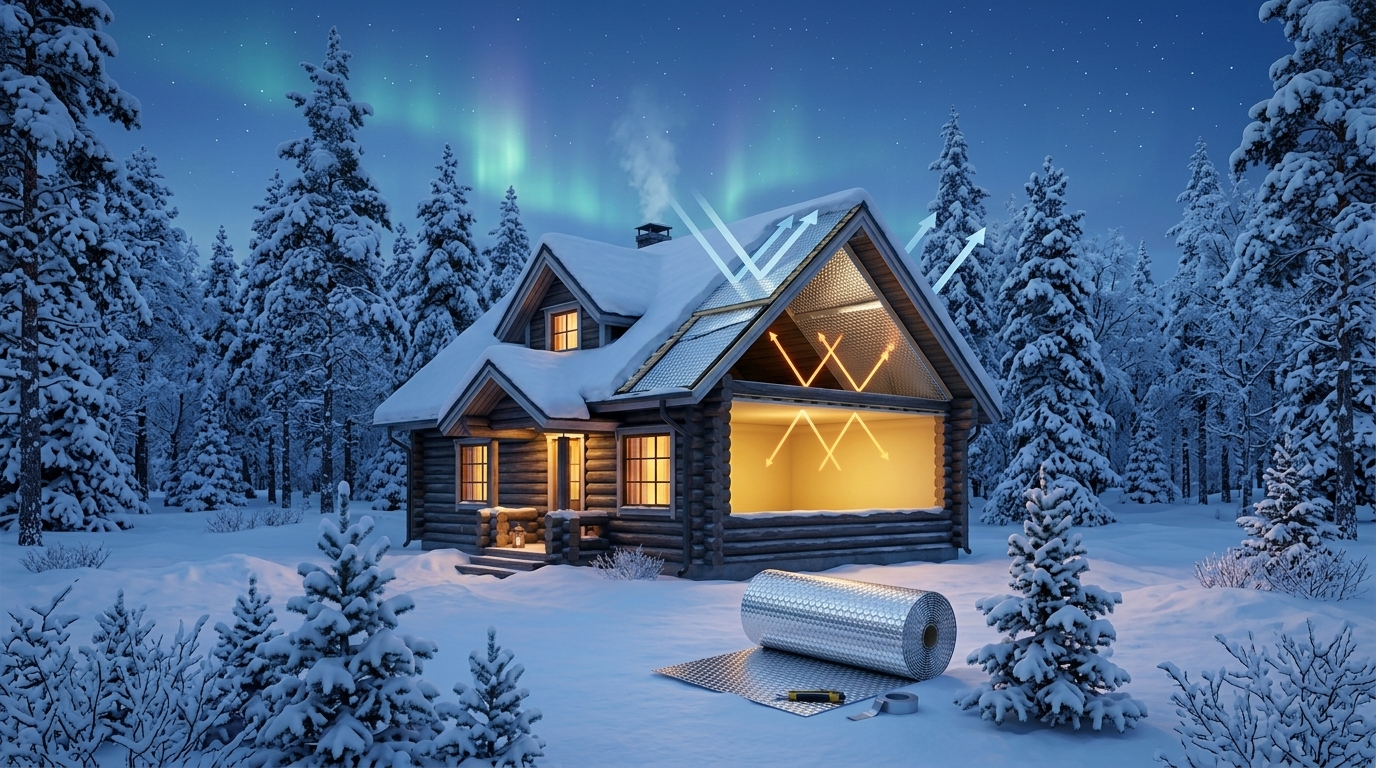
Reflective insulation uses pure aluminium faces that reflect up to 98% of radiant heat. Combined with sealed air or bubble layers, it does several useful jobs in a cold climate:
- Reflects heat back into the room. The foil face turned towards the warm interior sends radiant heat back, reducing how much escapes through the roof and walls.
- Adds a thermal break. The bubble and foam layers separate the warm and cold sides and slow heat flow through the product itself.
- Works as a radiant barrier in summer. Finnish summers are short but bright. The same foil turns back sun-heated roof radiation, which helps attics, cottages and metal-roofed workshops stay comfortable.
- Helps control moisture. Taped joints form a continuous, moisture-resistant, non-fibrous layer that supports a tight building envelope.
- Suits renovation. It is thin and light, so it fits in tight cavities, old rafter spaces and under cladding where thick wool will not.
The performance figure to remember: reflective insulation works best next to an air gap. A reflective cavity adds thermal resistance on top of the product’s own value, which is why installation detail matters as much as the product you choose.
Save Cool Bubble Insulation: The Recommended Choice for Finland
From the full Alumix product range, the Save Cool family is the best fit for cold-climate roofs, ceilings and walls. Both products below are multi-layer reflective bubble insulation, fire-retardant (FR) formulated, water-resistant and non-fibrous, so there is no dust, mould or pest nesting.
Save Cool Mega 40mm: for attics, lofts and ceilings
Save Cool Mega 40mm is a nine-layer multi-foil with five MTX aluminium foils and four 10 mm sealed air-bubble layers, 40 mm thick in total. It has the highest core R-value in the Save Cool range at R 1.02 m²K/W. With reflective air cavities, tested assembly values reach R 2.00 m²K/W in winter (heat flow up) with two 25 mm cavities, and an all-weather high thermal equivalent of R 5.22 m²K/W with two 75 mm air gaps.
In a Finnish attic, lay it over the ceiling boards beneath or in combination with your bulk insulation, keep a 20 to 90 mm air gap on the reflective face, and tape every seam. Rolls come in 0.60 and 1.20 m widths and 4, 6 and 8 m lengths.
Save Cool Triplex 25mm: for roofs, walls and tight spaces
Save Cool Triplex 25mm is a six-layer thermal-break insulation: three reflective foils over two 10 mm FR bubble cushions and a 5 mm EPE FR foam core. Core R is 0.67 m²K/W, and assembly values reach R 1.65 m²K/W in winter with two 25 mm reflective cavities. It is the slimmer option for behind metal cladding, in roof build-ups and in walls where space is limited.
If you are unsure which to choose, the rule of thumb is simple: pick Mega 40mm where you have room and want the most thermal resistance, and Triplex 25mm where space is tight. Use the product comparison tool to view specifications side by side.
Which Alumix Product for Which Finnish Building?
Beyond Save Cool, the Alumix range covers every part of a house and its outbuildings. Here is a quick guide for typical Finnish projects.
| Building or area | Recommended product | Why it suits |
|---|---|---|
| Attic and loft of a house | Save Cool Mega 40mm | Highest core R in the Save Cool range, lays over ceiling boards. See our attic installation guide |
| Roofs and walls with limited space | Save Cool Triplex 25mm | 25 mm thermal break with three foils |
| Cottage (mökki), garage or workshop | Bronze FR 4mm or Silver FR 8mm | Fire rated foil, easy to fit under roofing and on internal walls |
| Barns, farm and metal buildings | Multi+ 10mm | Net-reinforced, tear resistant. See metal building application and livestock application |
| Timber walls under cladding | RADWRAP T180 REF | Breathable, water resistant reflective house wrap |
| Floors and flat roofs | BLH-F 8mm | Thermal and impact sound insulation. See floor installation |
| Windows and doors | Curtain Shield | Reflective curtain you hang and remove as the seasons change |
| DIY loft or garage project | DIY Superior or DIY Platinum | Kits include eyelets and cable ties. See the DIY guide |
Installation Tips for Cold Climates
- Face the reflective side towards the heat source and always keep an air gap. Without a gap, the foil cannot do its best work.
- Seal all joints and overlaps with aluminium foil tape so the layer is continuous and airtight.
- Keep it on the warm side of the structure in a heated building, and plan the roof ventilation with your designer so moisture can escape.
- Keep clearances around heat sources. Leave at least 75 mm from downlights, and follow Finnish fire regulations around chimneys and sauna stoves. Reflective bubble insulation is not a substitute for sauna-rated foil inside a sauna room.
- Use the right tool for the job. The products cut with scissors or a sharp knife, and they are fibre-free and safe to handle. See our under-the-roof, internal wall and external wall installation pages.
A Simple Plan Before the Heating Season
- Start with the attic or roof. Warm air rises, so this is where most heat escapes.
- Add Save Cool Mega 40mm over the ceiling and keep the air gap.
- Seal the joints and check the loft hatch and service penetrations for draughts.
- Treat outbuildings and the cottage next, using Bronze FR or Silver FR.
- Finish with windows and floors using Curtain Shield and BLH-F 8mm.
If your project is an official renovation, ask your designer or the local building authority how it fits decree 4/2013. Energy advice for households and housing companies is also available from Motiva, the state-owned sustainable development company. Our team can supply test reports and product documentation on request through the contact page.
Frequently Asked Questions About Insulation in Finland
Is reflective insulation enough for a Finnish house?
No, not on its own. Finnish roofs and walls need substantial bulk insulation to meet the energy rules. Reflective insulation such as Save Cool is an excellent complement: it reflects radiant heat, adds a thermal break and a moisture-resistant layer, and helps where space is limited.
What is the best reflective insulation for an attic in Finland?
Save Cool Mega 40mm is the strongest option in the Save Cool range, with a core R of 1.02 m²K/W and five reflective foils. Lay it over the ceiling boards, keep an air gap on the reflective face and tape all seams.
Can I use Alumix insulation in a summer cottage or mökki?
Yes. Fire rated products such as Bronze FR 4mm and Silver FR 8mm are light, easy to fit under roofing or on walls, and suit unheated or seasonally heated buildings.
Does reflective insulation work in -30°C weather?
The foil reflects radiant heat regardless of outdoor temperature, and the bubble layers add a thermal break. For very low outdoor temperatures the best result comes from combining it with bulk insulation and a sealed air gap.
Do you supply distributors and contractors in Finland?
Yes. If you import, distribute or install building materials in Finland, see our distributor programme or write to us through the contact page.
Related Reading from Alumix
- Isolera smartare: guide to reflective aluminium foil insulation for Swedish homes (Finland’s Nordic neighbour)
- Reflekterende aluminiumsfolie isolering i Danmark: the complete Danish guide
- Jak ocieplić dom od fundamentów po dach: Polish complete guide
- The Complete UK Home Insulation Guide 2026: from loft to floor
- Insulation in Romania: beat 41°C summers and freezing winters
- Insulation benefits you should know about
Get Save Cool Insulation for Your Finnish Project
Whether you are upgrading an attic in Helsinki, a timber house in Tampere, a workshop in Oulu or a lakeside cottage in Savonlinna, the right reflective layer helps you keep more of the heat you pay for. Browse the full Alumix range, or contact our team for a recommendation, samples and pricing. You can also email info@alumixinsulationglobal.com.
Product values are from Alumix specifications and are subject to verification against current test reports. Performance depends on installation method and air gap. Building regulations change, so confirm requirements with your designer or local building authority.
Leave a Reply