
 Switzerland
Current Weather in Switzerland: The Alumix Insulation Guide for Every Region
Switzerland is a small country with an unusually large number of climates. On any given afternoon in mid-September, you can find sunbathers in Ticino, hikers in fleece jackets in the Bernese Oberland, and the first snow flurries dusting the peaks above Zermatt — all at the same time, all in the same country. That variety is exactly why good insulation in Switzerland can’t be a one-size-fits-all product.
Below, we break down what’s actually happening in the Swiss sky right now, why the country’s building stock is more exposed to that variability than most, and which products from the Alumix reflective insulation range are the right match for each region and roof type.
Switzerland’s Weather Right Now: A Country of Four Climates in One Afternoon
As of September 14, 2026, Switzerland is enjoying a late-summer stretch of high pressure in the lowlands, according to MeteoSwiss — but the Alps are already giving homeowners a preview of winter.
- Zurich and the Central Plateau: Around 20°C (68°F) with clear skies and a forecast high near 24°C (75°F) today. A wetter, cooler Wednesday is expected (highs around 21°C / 70°F, 70% chance of rain) before conditions dry out again toward the weekend.
- Geneva and the Lake Geneva region: Warmer still, at roughly 23°C (73°F) currently with a high near 28°C (82°F) today and tomorrow — genuine Indian-summer conditions before a cooler, showery midweek dip.
- Lugano and Ticino: Switzerland’s sun-belt is living up to its reputation, sitting around 24°C (74°F) now with highs near 27°C (80°F) and warm overnight lows in the mid-teens Celsius — noticeably milder nights than north of the Alps.
- Zermatt and the high Alps: A completely different story. Current temperatures sit around 12°C (54°F), and by Thursday and Friday this week, forecast highs drop to 8–9°C (47–49°F) with overnight lows flirting with freezing — 2.7°C (37°F) and 0.6°C (33°F) — and a real chance of snow at altitude. Winter isn’t coming to the high Alps; for practical purposes, it’s already knocking.
That gap — sunbathing weather in Lugano and near-freezing nights in Zermatt, on the same day — is the defining feature of the Swiss climate, and it’s the reason insulation strategy needs to be regional rather than generic.
Why Switzerland’s Buildings Need Insulation More Than Most Countries
Switzerland’s climate swings would be a minor inconvenience if the country’s buildings were new and tightly sealed. They generally aren’t. Roughly half of Switzerland’s building stock is over 40 years old, and buildings account for around 45% of the country’s total energy consumption — a disproportionate share driven largely by heat lost through poorly insulated roofs, attics, and façades. Estimates from Swiss building-envelope specialists suggest well over a million homes are in urgent need of energy-efficiency upgrades, and that better thermal insulation alone can cut heating costs by up to 60% in an average building.
That combination — an old, energy-hungry building stock sitting inside one of Europe’s most climatically varied countries — is exactly the situation reflective insulation was designed for. Cantons across Switzerland now offer subsidies for building-envelope upgrades precisely because roof and attic insulation deliver some of the fastest, most visible returns of any renovation measure.
The Alumix Difference: Insulation That Works Both Ways
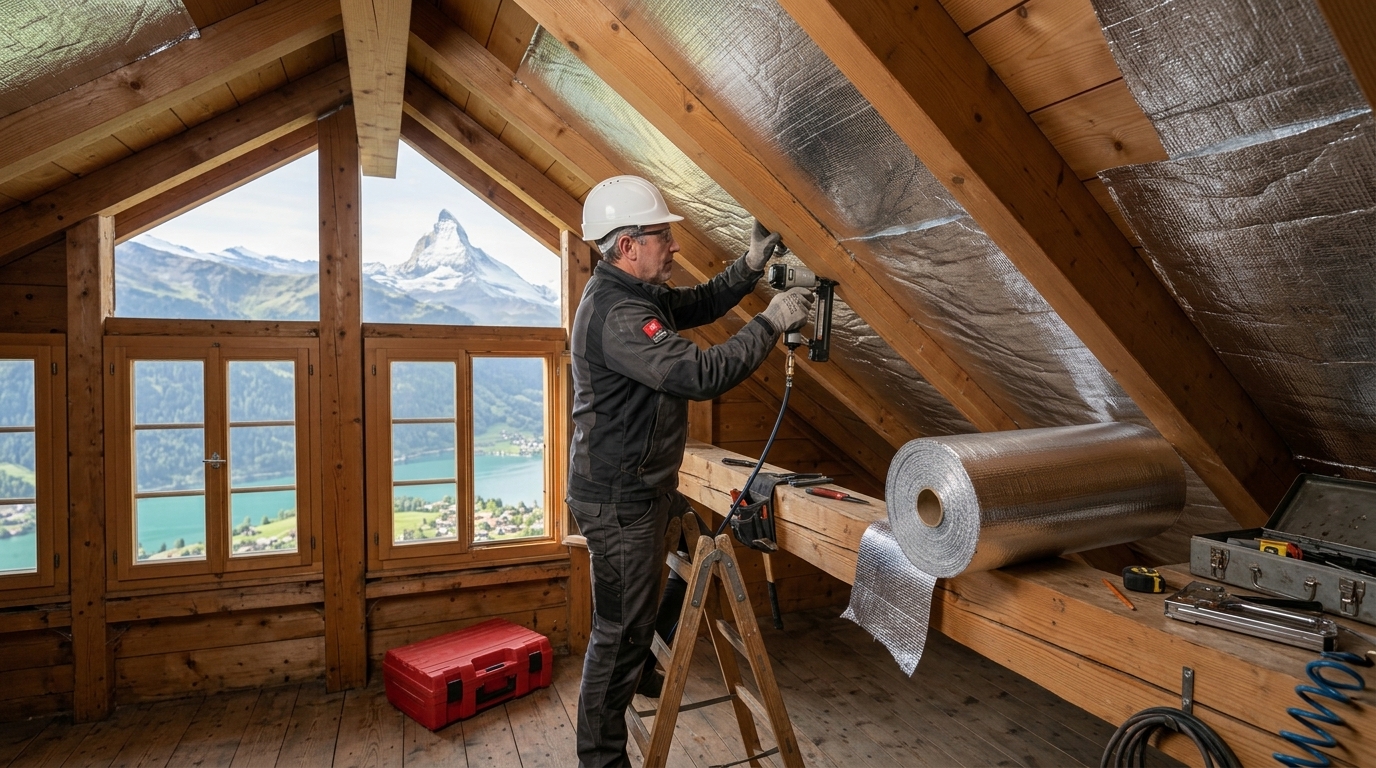
Most traditional insulation (mineral wool, glass fibre) works by trapping air to slow down heat transfer — useful in winter, largely irrelevant in summer. Alumix’s reflective foil insulation works on a different principle: it reflects up to 98% of radiant heat rather than merely slowing it down.
In practice, that means the same roll of Alumix insulation:
- In winter, reflects the room’s own heat back downward instead of letting it radiate out through the roof — ideal for the near-freezing Alpine nights already showing up in this week’s Zermatt forecast.
- In summer, reflects the sun’s radiant heat away from the roof before it ever enters the building — exactly what’s needed under the strong, direct sun currently sitting over Ticino and the lowland cities.
Most Alumix rolls use double-sided aluminium foil (roughly 99% pure) bonded to a fibreglass or bubble core, installed with a 20–90mm air gap for the reflective effect to work properly. That dual-direction performance is the main reason reflective insulation suits Switzerland’s climate better than a single-purpose product: the same installation earns its keep in both January and July.
Matching Alumix Products to Switzerland’s Regions
Alpine chalets and mountain properties (Zermatt, Graubünden, Valais)
With snow already forecast at altitude this week, roof and loft insulation is the priority here. Alumix Extra is the heaviest-duty option in the range — a 16mm triple-foil, mesh-reinforced roll built for maximum thermal retention under harsh, sustained cold. For roof and rafter retrofits in chalets and mountain lodges, Alumix DIY Platinum offers the top tier of the DIY roll family, with double-sided 99% foil rated to reflect up to 98% of radiant heat.
City apartments and older buildings (Zurich, Basel, Bern)
Many pre-1975 Swiss apartment buildings have suspended or dropped ceilings that make full roof renovation impractical. Advance Ceiling is sized specifically for 60cm x 60cm ceiling tiles, so it slots into existing drop-ceiling grids without construction work. The budget-friendly UNO X10 Ceiling (single-sided) and DUO X10 Ceiling (double-sided) versions are ideal for landlords or renovators insulating multiple rooms or units cost-effectively.
Ticino and other south-facing, sun-exposed homes
With Lugano running several degrees warmer than the rest of the country, solar heat gain through the roof is a bigger problem here than winter cold. Alumix Gold Multi-Layers and Double Bubble FR both add reinforced, load-bearing cores and fire-retardant treatment, making them well suited to walkable attic spaces that take on heavy solar loading through the day.
DIY roof and loft renovators anywhere in Switzerland
For homeowners tackling their own attic insulation, the DIY roll family is built as a simple good–better–best ladder: Alumix DIY Basic for budget-conscious retrofits, Alumix DIY Superior as the mid-tier option, and DIY Platinum at the top. All three ship in 1.2m-wide rolls (6m, 8m, or 10m lengths) and install without specialist tools.
Draughty older windows and doors
Given that poorly insulated windows can lose heat at a much higher rate than surrounding brickwork, the Curtain Shield DIY — a heat-reflective curtain sized from S (1.05m x 1.35m) to XL (1.20m x 2.75m) — is a genuinely useful quick fix for older Swiss buildings with single glazing, requiring no installation tools at all.
General wall, roof, and outbuilding coverage
For straightforward wall or roof cavities, the Silver 6mm, Silver 8mm, Bronze 4mm, and single-sided Classic 4mm lines cover a range of budgets and thicknesses, each available in basic and fire-retardant versions. For larger structures such as barns, workshops, or storage buildings, the metallised-film DUO X10, UNO X10, and Alumix P2 rolls (95% reflectivity) offer a cost-effective way to cover large roof areas.
Save Cool Bubble Insulation: The Recommended Choice for Swiss Winters
For Swiss homes facing cold Alpine winters, the Save Cool family from the Alumix product range is an excellent fit for roofs, lofts and walls. Both products are multi-layer reflective bubble insulation, fire-retardant (FR) formulated, water-resistant and non-fibrous, so there is no dust, mould or pest nesting.
Save Cool Mega 40mm: for lofts, attics and ceilings
Save Cool Mega 40mm is a nine-layer multi-foil with five MTX aluminium foils and four 10 mm sealed air-bubble layers, 40 mm thick in total. It has the highest core R-value in the Save Cool range at R 1.02 m²K/W, and tested assembly values reach R 2.00 m²K/W in winter with two 25 mm reflective cavities. Lay it over ceiling boards or under rafters in alpine chalets and older city buildings, keep a 20 to 90 mm air gap on the reflective face, and tape every seam.
Save Cool Triplex 25mm: for roofs, walls and tight spaces
Save Cool Triplex 25mm is a six-layer thermal-break insulation: three reflective foils over two 10 mm FR bubble cushions and a 5 mm EPE FR foam core. Core R is 0.67 m²K/W, with assembly values up to R 1.65 m²K/W in winter. It is the slimmer option behind cladding, in roof build-ups and in walls where space is limited.
Rule of thumb: choose Mega 40mm where you have room and want the most thermal resistance, and Triplex 25mm where space is tight.
Installation Notes for Swiss Conditions
- Leave the air gap. Reflective foil needs a 20–90mm gap between the foil face and the roof or ceiling surface to do its job — foil pressed flat against a surface loses most of its reflective benefit.
- Check local fire regulations. Swiss cantons set their own building and fire-safety rules (Brandschutz / protection incendie), so confirm which fire-retardant (FR) variant is required for your building type before installing near living spaces.
- Consider moisture. Homes near Swiss lakes and rivers often deal with higher ambient humidity — the moisture-resistant, mould-resistant properties of the Alumix range are particularly relevant in these locations.
Frequently Asked Questions
Does reflective insulation actually work in cold climates like the Swiss Alps?
Yes. Reflective foil insulation reflects radiant heat rather than absorbing it, which means it reflects a room’s own heat back inward in winter just as effectively as it reflects solar heat outward in summer — a genuine advantage in a country with Switzerland’s temperature swings.
How much can better insulation reduce heating costs in a Swiss home?
Industry estimates suggest a well-insulated building envelope can cut heating costs by up to 60% compared with an unrenovated older building, since roofs, attics, and façades are typically where the most heat is lost.
What size Alumix product do I need for a typical Swiss attic or ceiling?
For open attic or roof spaces, roll products (DIY Basic/Superior/Platinum, Silver, Bronze, Classic) sized 1.2m-wide by 6–20m are typical. For suspended ceiling grids, the 60cm x 60cm Advance Ceiling, UNO X10 Ceiling, and DUO X10 Ceiling tiles fit standard tile dimensions directly.
Is Alumix insulation fire-safe for use in Swiss buildings?
Several lines — including Silver, Bronze, Double Bubble, and Multi-Layers — are available in fire-retardant (FR) versions. Always confirm the fire-safety requirement for your specific building type with your canton before installing.
The Bottom Line
Switzerland’s weather isn’t one story — it’s four or five stories happening at once, from sunbaked Ticino terraces to snow already dusting the peaks above Zermatt. An insulation product that only works in one direction leaves half of that climate unaddressed. Alumix’s reflective range is built to work both ways, in the same installation, whether you’re insulating a mountain chalet ahead of the first snowfall or a Lake Geneva apartment ahead of the next heatwave.
Explore the full Alumix catalogue to find the right fit for your building, or get in touch for a recommendation tailored to your specific roof, region, and renovation budget.
Leave a Reply