
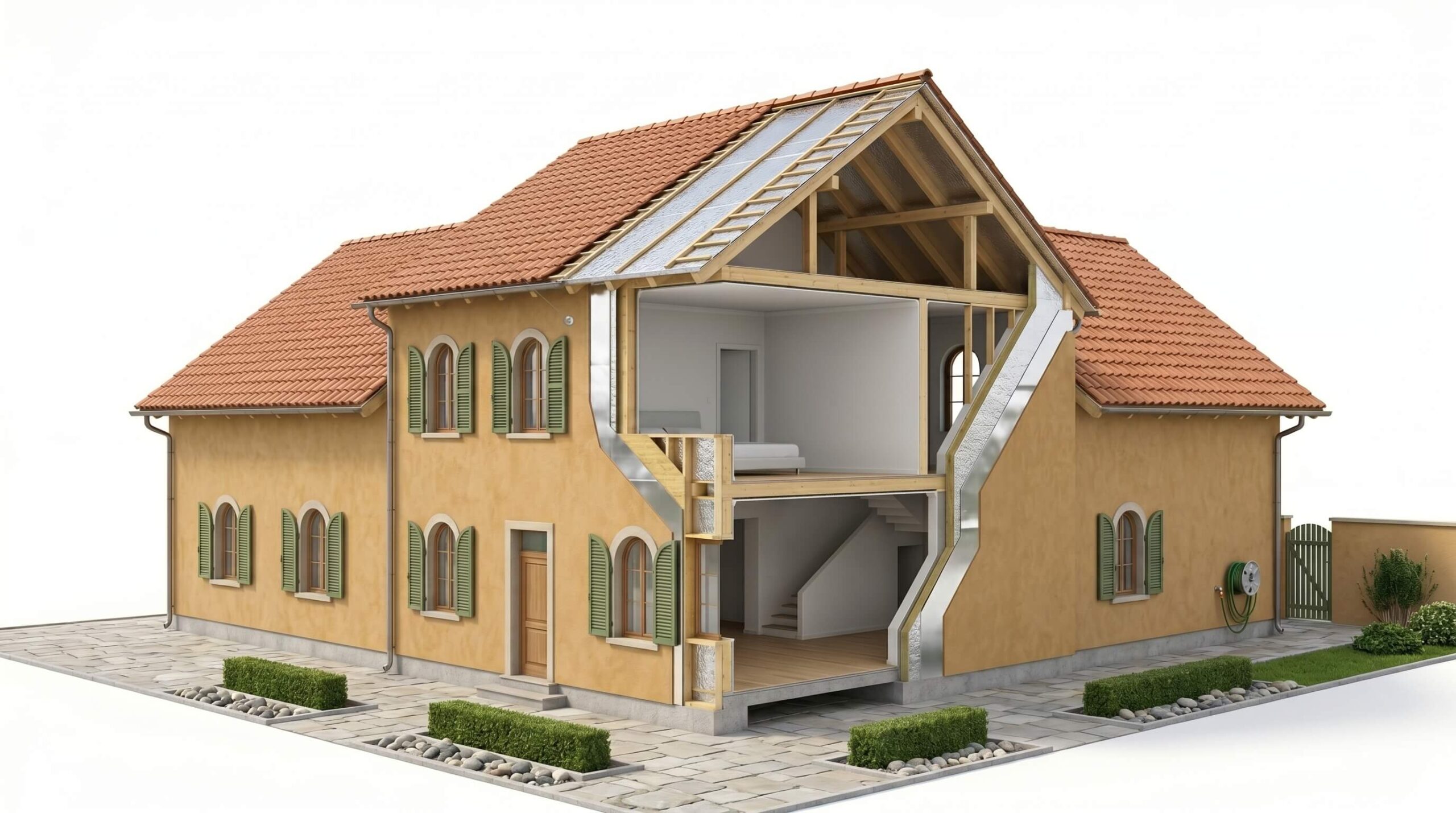
 Italy
ItalyWhy Italian Homes Are Losing the Battle Against Summer Heat — And How to Win It Back
By Alumix Insulation Global | June 2026
Italy has always known how to live with heat. The afternoon riposo, the thick stone walls of historic city centres, the deep-set windows and heavy shutters of rural farmhouses — centuries of accumulated wisdom about keeping a building cool without mechanical intervention. Walk into a well-preserved medieval home in Umbria or Puglia on a July afternoon and you will find it genuinely cool inside, despite no air conditioning, no modern insulation, and walls that have been standing for five hundred years.
Walk into almost any apartment built in the 1970s, 1980s, or 1990s in Milan, Rome, or Naples, and you will find the opposite. Thin concrete construction, minimal thermal mass, large glazed balcony doors facing south and west, flat or low-pitch roofs with no meaningful insulation layer. These buildings were constructed during an era of cheap energy and optimistic assumptions about what the Italian climate would continue to look like. Both of those assumptions have since collapsed.
Italy now faces a dual crisis every summer. The heat is more intense and more prolonged than it used to be. And the buildings most Italians live in were not built to handle it.
The Italian Summer Has Changed
Northern Italy, once reliably temperate through much of the summer, now experiences sustained heatwaves that push temperatures past 38°C for days at a time. The Po Valley — home to Milan, Turin, Bologna, and millions of Italians — sits in a geographic basin that traps heat and humidity with particular effectiveness. Central Italy bakes. The south, which always ran hot, now routinely exceeds 40°C during peak summer months.
What has changed is not just the peak temperature but the duration. Heatwaves that used to last three or four days now stretch to ten or twelve. Nights that used to offer relief now remain uncomfortably warm well past midnight. The thermal mass that made old stone buildings so effective at staying cool — absorbing heat slowly during the day and radiating it away overnight — no longer has enough overnight coolness to recharge. The buffer that made traditional Italian architecture work is being eroded by warmer nights.
Modern construction has no such buffer to lose. It never had one. Thin concrete walls and lightweight roof structures heat up fast and stay hot. The building does not absorb and delay heat — it simply transmits it, almost directly, from the sun-baked exterior surface into the living space.
How Italian Buildings Are Failing Their Occupants
The problem in Italian residential construction is concentrated in three areas.
The roof is first. Flat concrete roof slabs are commonplace across Italian apartment buildings and postwar residential developments. These surfaces absorb solar energy with almost no resistance, reaching extreme surface temperatures by early afternoon. With no reflective or resistive insulation layer beneath them, all of that stored heat conducts and radiates directly into the top-floor apartments below. Top-floor living in an Italian apartment block in August is genuinely miserable without serious mechanical cooling, and the residents on those floors pay electricity bills to match.
The external walls are second. Italy’s postwar building boom produced millions of apartments in concrete frame construction with hollow clay block infill walls and a thin render coat outside. These walls have a low thermal mass compared to solid stone and offer minimal resistance to heat transfer. By mid-afternoon on a hot day, an uninsulated west-facing wall in Rome is warm to the touch on the interior surface — the heat has conducted straight through.
The third problem is less visible but equally significant. Italian buildings are full of thermal bridges — concrete columns, beams, and floor slabs that extend from the exterior to the interior of the structure without interruption. These create direct pathways for heat to bypass any insulation that does exist, conducting energy straight into the building fabric. Addressing thermal bridges properly requires systematic attention to the whole building envelope, not just the most obvious surfaces.
The Air Conditioning Spiral
Italy’s air conditioning market has grown explosively over the past two decades. Split-system units are now standard in most Italian urban apartments. But ownership of an AC unit does not automatically translate into affordable summer comfort — not when the building the unit is trying to cool is working against it.
An AC unit installed in a poorly insulated Italian apartment on the top floor of a 1980s condominium is fighting the roof above it, the walls around it, and the thermal bridges threading through the structure. It runs almost continuously during peak afternoon hours. It consumes large amounts of electricity at precisely the time when Italian grid prices are highest. It cools the air temporarily, but the moment it cycles off the temperature climbs back immediately because the building envelope has no ability to hold the coolness in.
The Italian electricity market is not forgiving in this context. Residential tariffs spike in summer, and peak-hour pricing during July and August can make running a heavily loaded AC system extraordinarily expensive. The households most affected are often those in older, poorly insulated buildings — typically lower-income renters or elderly residents on fixed incomes, living in exactly the kind of postwar stock that was built with the least thermal consideration.
Insulation changes this equation fundamentally. When a building’s roof and walls have a proper reflective barrier, the heat load entering the building is reduced at source. The AC unit has less work to do. It runs in shorter cycles. The interior temperature holds between those cycles rather than immediately rebounding. The electricity consumption falls, the bills fall, and the unit itself lasts longer because it is no longer running at continuous maximum load for twelve hours a day.
The Right Solution for Italian Buildings
Alumix Insulation Global’s reflective insulation range addresses the specific challenges of Italian construction across both new build and retrofit applications.
For flat concrete roof slabs — the dominant problem surface in Italian urban apartment buildings — the Multi Layers TRP-FRNS multi-layer reflective insulation system provides the most comprehensive solution. Applied beneath the roof slab or within the roof build-up, it creates a reflective barrier that intercepts radiant heat before it can radiate downward into the apartment below. Its multi-layer construction provides genuine thermal resistance across the full range of heat transfer mechanisms — radiant, conductive, and convective — rather than addressing only one. Fire retardant certification to UL94 standards makes it appropriate for the multi-occupancy residential buildings where this problem is most acute. Its acoustic performance is an additional benefit in densely occupied Italian apartment blocks where noise transmission between floors and through walls is a persistent quality-of-life concern.
For external wall applications — particularly the south and west-facing elevations that take the hardest solar punishment through Italian summer afternoons — the Radiant Barrier Woven provides a durable, high-performance reflective layer that integrates into external wall assemblies as an underlay or cavity component. Reflecting up to 95% of incoming radiant heat, it substantially reduces the thermal load conducted through the wall structure and noticeably reduces interior wall surface temperatures during peak heat periods. Its woven substrate gives it the mechanical toughness required for installation in wall cavities and external cladding systems where the material needs to handle tension and compression without degrading.
For top-floor apartments where the ceiling is the primary heat gain surface, the DUO X10 Ceiling offers an effective solution that can be installed above the existing ceiling finish or within a new suspended ceiling assembly. Its dual-sided metalised foil surface reflects downward radiant heat from the hot roof slab back upward, while simultaneously improving winter thermal retention. In a top-floor Italian apartment where summer ceiling temperatures can make the upper portion of the room uncomfortably warm even with AC running, the DUO X10 Ceiling makes a measurable difference to both comfort and cooling costs.
For targeted retrofit applications — a single problematic room, a roof terrace ceiling, a stairwell skylight surround, a garage or storage space being converted to habitable use — the Poly Care PC4G rigid 4mm double-sided gold foil panel provides 98% radiant heat reflection in a practical sheet format. At 120cm × 100cm per sheet it covers significant areas quickly, cuts cleanly to size, and can be fitted with standard fixings without specialist tools or trades.
Italy’s Energy Efficiency Regulations Are Tightening
The regulatory context in Italy is shifting in ways that make thermal insulation upgrades increasingly relevant beyond simple comfort and cost savings. The European Union’s Energy Performance of Buildings Directive is driving member states toward mandatory energy efficiency improvements in the existing building stock. Italy, with one of Europe’s oldest and least energy-efficient housing stocks, faces a significant challenge in meeting these targets.
The Italian Superbonus scheme, which offered substantial tax incentives for building energy efficiency upgrades, demonstrated both the enormous appetite among Italian property owners for improvement and the scale of the work required. While the scheme’s terms have changed since its peak, the underlying regulatory direction has not: buildings in Italy will increasingly need to demonstrate their energy performance, and those that cannot will face reduced rental values, restricted financing options, and eventual compliance requirements.
Alumix Insulation Global products carry UL94, Green Tag, and TÜV certifications, providing the documented performance evidence that compliance-focused applications require. For Italian property owners, building managers, and developers navigating energy efficiency regulations, working with certified products from a manufacturer with 33 years of international export experience is not a detail — it is the foundation of a defensible upgrade.
What Italy’s Building Stock Actually Needs
The challenge facing Italian housing is not small and it is not going to resolve itself. Millions of apartments in buildings constructed between 1950 and 1990 have essentially no meaningful thermal insulation by modern standards. Their occupants are spending heavily on air conditioning every summer, living in discomfort despite that spending, and facing a regulatory environment that will increasingly demand improvement.
The path forward is not to rebuild. It is to retrofit intelligently. Reflective insulation applied to roofs, external walls, and ceilings can dramatically reduce the heat load entering these buildings without structural intervention, at costs that are recoverable through energy savings within a realistic timeframe.
Italy built some of the world’s most thermally intelligent architecture over the past thousand years. Then it spent fifty years forgetting what it knew. Alumix Insulation Global’s certified reflective insulation range offers a practical route back to buildings that stay cool when the summer demands it — without the electricity bill of a building that has given up trying.
Alumix Insulation Global — certified thermal insulation solutions for residential, commercial, and industrial applications worldwide. Learn more at alumixinsulationglobal.com
Leave a Reply