
 Greece
Keeping Greece Cool: Why Thermal Insulation is the Smartest Investment Greek Homeowners Are Not Making
By Alumix Insulation Global | June 2026
Greece runs on air conditioning. No other country in Europe comes close to the adoption rate — nearly every household owns at least one unit, and in urban Athens, Thessaloniki, and the island towns that swell with tourists every summer, running the AC from June through September is simply accepted as a fact of life. It is as Greek a summer ritual as eating late, swimming at dusk, and complaining about the electricity bill.
That last part is important. Because the electricity bill in Greece during summer is not a minor inconvenience. It is a genuine financial burden for many households, and it is getting heavier. Greek residential electricity prices have risen sharply over recent years, driven by a combination of energy market volatility, grid infrastructure pressures, and the brute reality that when an entire country cranks up its air conditioning simultaneously on a 40°C July afternoon, the cost of generating and distributing that power goes up for everyone.
The response of most Greek households to rising electricity costs has been to either absorb the expense, reduce comfort, or both. What far fewer have done is address the root cause — the fact that the buildings they are trying to cool were never properly insulated in the first place.
The Greek Building Stock: A Thermal Problem Decades in the Making
Greece’s housing stock is dominated by reinforced concrete apartment buildings — the polykatoikia that define the visual landscape of every Greek city and town. Built rapidly during the postwar decades of economic growth and urbanisation, these buildings were constructed to house people quickly and affordably. Thermal performance was not a priority. In many cases it was not a consideration at all.
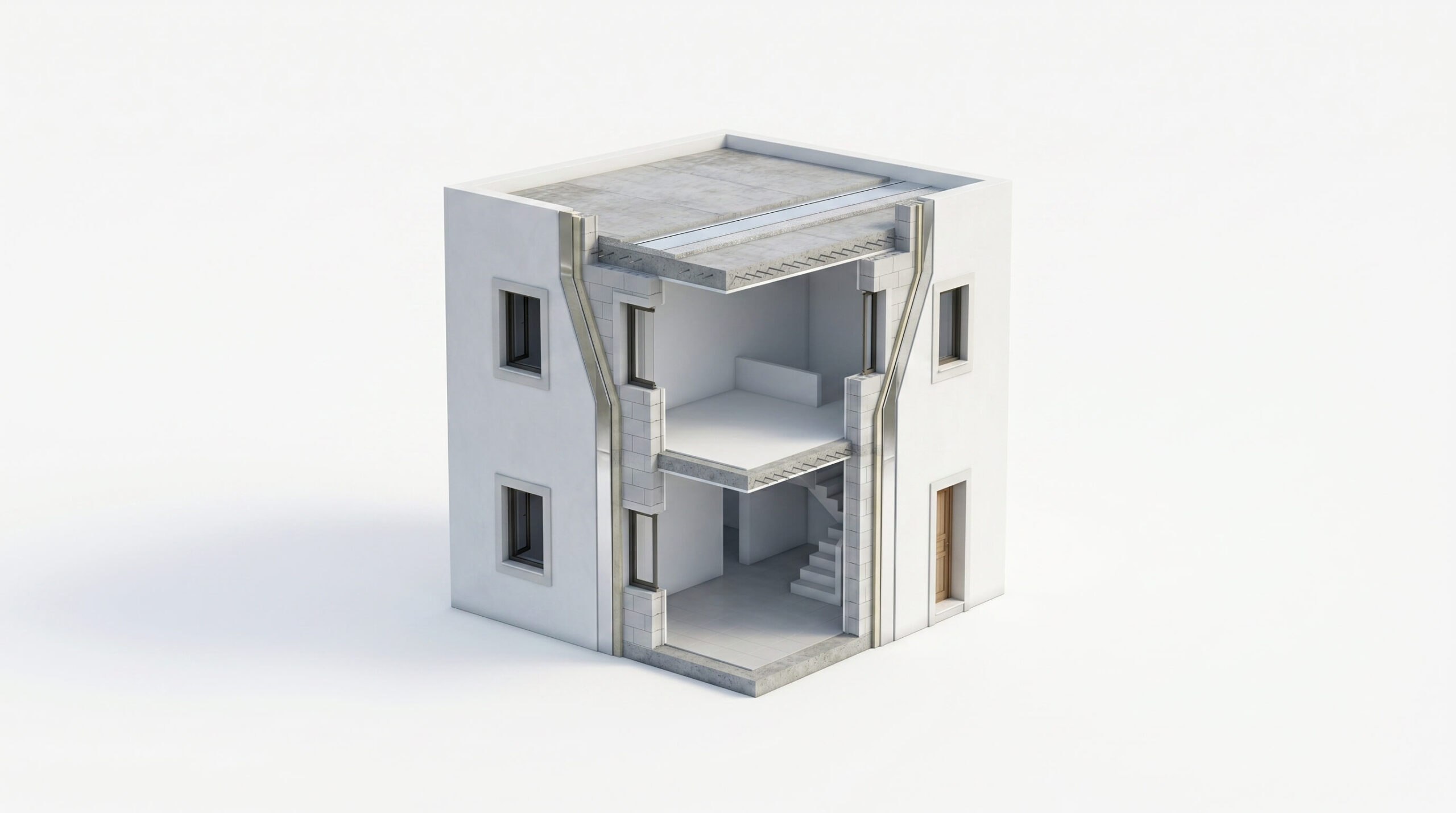
The typical Greek polykatoikia has concrete frame construction, hollow clay block infill walls, single or early double glazing, and a flat reinforced concrete roof slab. The roof sits directly exposed to the Greek summer sun with minimal or no insulation between the exterior surface and the apartments below. The walls, similarly, offer little resistance to the heat conducted and radiated through them during peak afternoon hours.
This construction type is thermally catastrophic in a Mediterranean climate. Concrete has high thermal mass, which means it absorbs a great deal of solar energy during the day and releases it slowly — including throughout the night, when residents are trying to sleep and the outdoor temperature has finally dropped. The building becomes a thermal battery that charges during the day and discharges its stored heat into living spaces through the evening and night. Running AC through the night is not a luxury in these buildings. It is a necessity created by the building’s own thermal behaviour.
Rural and island Greek housing presents a different but equally challenging picture. Traditional stone construction performs better thermally, but many properties built during the 1970s through 1990s in villages and island towns use the same lightweight concrete block construction as urban buildings, often with even less attention to detailing and thermal continuity. Holiday homes and rental properties — an economically significant part of the Greek built environment — frequently sit empty through winter and are then expected to become comfortable immediately upon occupation in June, with no thermal envelope capable of supporting that expectation without intensive mechanical cooling.
What 99% AC Adoption Actually Means
Greece’s near-universal air conditioning adoption is often cited as evidence that the country has solved its summer heat problem. It has not. It has found an expensive workaround for a building stock problem, and that workaround is becoming less affordable every year.
Consider what happens in a typical Athens apartment on a day when the temperature reaches 38°C. The AC unit switches on in the morning as the interior temperature rises. By midday it is running at full capacity, fighting not just the outdoor air temperature but the radiant heat pouring through the roof slab above and the walls around it. The concrete fabric of the building, which has been absorbing solar energy since dawn, is now a heat source in its own right, radiating stored energy into the living space from every surface simultaneously.
The AC unit is powerful enough to maintain a tolerable indoor temperature, but only by running almost continuously. Switch it off for an hour and the temperature climbs rapidly, because the building has no capacity to hold coolness — no insulation to slow the heat gain, no reflective barrier to intercept radiant energy at the envelope surface. The moment mechanical cooling stops, thermal reality reasserts itself immediately.
This is an extraordinarily inefficient way to live. The electricity consumed is enormous. The wear on the AC equipment is severe. And the comfort achieved, while real, is entirely dependent on an uninterrupted power supply and an affordable electricity tariff — neither of which can be taken for granted in the Greek context.
The alternative is to give the building itself some thermal capability before asking the AC to do all the work. A properly insulated roof and wall assembly changes the fundamental dynamics. The heat load entering the building is reduced at source. The interior temperature rises more slowly. The AC runs for shorter periods to maintain comfort. The electricity consumed falls substantially. And when the unit does cycle off, the insulated building holds its coolness long enough for the occupants to notice the difference.
The Roof: Greece’s Most Neglected Thermal Surface
In the Greek climate, the roof is where the insulation battle is won or lost. The flat concrete roof slabs that top almost every urban Greek building are exposed to some of the most intense solar radiation in Europe. On a clear summer day in Athens, solar irradiance levels are among the highest on the continent. The roof surface temperature on an uninsulated concrete slab can exceed 80°C by early afternoon. That is not the air temperature — that is the surface temperature of the structure above your head.
Below that slab, separated only by whatever ceiling finish happens to exist, are the top-floor apartments. The residents of these apartments pay more to cool their homes than anyone else in the building. They sleep less comfortably. They run their AC longest and hardest. And in older buildings with no lift, they are often the oldest and most financially constrained residents — the ones least able to absorb the electricity costs the building’s thermal failure imposes on them.
Insulating the roof of a Greek polykatoikia is the single most impactful thermal upgrade possible. It benefits every top-floor resident immediately and improves the overall thermal behaviour of the building by reducing the heat that radiates downward through the structure into lower floors. In a building where the roof is shared infrastructure — legally and practically — a collective decision by the building’s residents to insulate the roof is an investment that pays returns to everyone.
Products Built for the Greek Climate
Alumix Insulation Global’s reflective insulation range addresses Greek building challenges directly, with products suited to both the dominant flat-roof concrete construction and the wall and ceiling applications that complete a comprehensive thermal envelope.
For flat concrete roof slabs the Multi Layers TRP-FRNS is the primary solution. This multi-layer reflective insulation system creates a high-performance thermal and radiant barrier within the roof assembly, dramatically reducing the heat transmitted downward through the slab. Its fire retardant certification to UL94 standards is essential for multi-occupancy residential buildings. Its acoustic properties address the secondary comfort concern that Greek apartment living makes unavoidable — sound transmission through concrete structures is a persistent quality-of-life issue in the polykatoikia, and an insulation layer that also absorbs sound is a meaningful additional benefit. The TRP-FRNS handles the full range of heat transfer mechanisms present in a concrete roof assembly — radiant energy from the superheated slab surface, conducted heat through the concrete mass, and convective heat from the air space beneath — making it a comprehensive rather than partial solution.
For external walls the Radiant Barrier Woven provides robust reflective performance in a tear-resistant woven substrate that handles the mechanical demands of wall cavity and external cladding installation. In south and west-facing walls receiving direct afternoon sun across the long Greek summer, a 95% radiant heat reflection barrier reduces interior wall surface temperatures noticeably and decreases the conducted heat load that the AC must overcome. For the island and coastal properties where salt air and wind create additional durability demands on building materials, the woven construction of this product offers greater longevity than foil-only barriers in exposed conditions.
For ceiling applications within apartments — particularly top-floor units where the ceiling is the primary heat gain surface — the DUO X10 Ceiling installs above or within the ceiling assembly and creates a dual-sided reflective barrier that intercepts downward radiant heat from the hot slab above while simultaneously improving winter thermal retention. The product’s air bubble core adds a layer of resistive insulation to complement its reflective performance, making it effective across the full range of conditions a Greek ceiling faces across the year.
For targeted applications and retrofit projects where access and disruption need to be minimised, the Save Cool Mega 40mm and Triplex 25mm address the full roof space insulation requirement. The Mega 40mm provides maximum thermal resistance in a thick-format reflective insulation ideal for roof spaces where performance is the priority. The Triplex 25mm offers a three-layer reflective system in a slimmer profile suited to ceiling voids, wall cavities, and retrofit applications where the available space is limited but the performance requirement is not.
Regulatory Compliance and Energy Certification
Greece’s energy efficiency regulatory framework has evolved significantly under EU pressure, and the direction of travel is clear. Buildings require energy performance certificates for sale and rental. Minimum energy performance standards are being progressively tightened. Commercial buildings and public sector properties face increasingly specific requirements for envelope thermal performance.
For Greek property owners managing rental portfolios — a significant category in a country with high property ownership rates and active short-term rental markets — energy certification is not an abstract regulatory concern. It affects rental values, occupancy rates, and the ability to market properties effectively to an increasingly energy-conscious market. A building with a poor energy rating is a harder let and a harder sale. An upgrade that meaningfully improves the thermal envelope improves the energy certificate, which improves the commercial position of the property.
Alumix Insulation Global products carry UL94, Green Tag, and TÜV certifications, providing the documented performance evidence that energy certification processes require. With 33 years of manufacturing experience and export to more than 20 countries, the company’s products meet the standards that compliance-focused applications demand — not just in performance but in the documentation and certification that Greek regulatory processes increasingly require as evidence.
The Economics Are Straightforward
Greece has some of the highest air conditioning penetration and some of the highest residential electricity costs in Europe. The combination creates a financial case for insulation that is unusually clear.
A Greek household running air conditioning heavily through a four-month summer, in a poorly insulated concrete apartment, is spending significantly on electricity that a properly insulated building would not require. The reduction in cooling load from a well-insulated roof and walls translates directly into fewer hours of AC operation, lower peak consumption, and meaningfully lower bills. The insulation investment is recovered through those savings over a period that the Greek climate makes shorter than almost anywhere else in Europe — because the problem the insulation is solving is more severe, more sustained, and more expensive than it is further north.
Beyond the direct electricity savings, there is the equipment longevity argument. AC units in poorly insulated Greek buildings run extremely hard for extremely long periods every summer. Units that might last fifteen years in a well-insulated Northern European home often need replacement in eight or ten years in a Greek apartment where they run almost continuously through a four-month season. Reducing the operating load extends equipment life, defers replacement costs, and reduces the environmental impact of manufacturing and disposing of HVAC equipment prematurely.
Greece Does Not Have a Cooling Problem
It has an insulation problem that it is solving expensively with cooling equipment.
The distinction matters because the two problems have different solutions. A cooling problem is solved by buying more or better air conditioning. An insulation problem is solved by reducing the heat load that the cooling equipment has to overcome — and in doing so, making the cooling equipment more effective, longer-lived, and less expensive to run.
Greece has been solving its insulation problem with cooling equipment for fifty years. The electricity bills show the cost of that approach. The building stock shows its limits. And the combination of rising energy prices, tightening efficiency regulations, and increasingly severe summer heat is making the status quo untenable for a growing number of Greek households and property owners.
Alumix Insulation Global’s certified reflective insulation range — the Multi Layers TRP-FRNS, Radiant Barrier Woven, DUO X10 Ceiling, Save Cool Mega 40mm, and Triplex 25mm — provides the thermal envelope upgrade that Greek buildings have needed for decades. The technology is proven, the certifications are in place, and the financial case has never been stronger.
Greece runs on air conditioning. It does not have to cost this much to do so.
Alumix Insulation Global — certified thermal insulation solutions for residential, commercial, and industrial applications worldwide. Learn more at alumixinsulationglobal.com
Leave a Reply