
 Europe
Beating the Mediterranean Heatwave: How Passive Insulation Saves Your AC — and Your Wallet
By Alumix Insulation Global | June 2026
Spain does not ease you into summer. One week you are wearing a jacket in the evening, and the next the thermometer is pushing 38°C before noon and the air conditioning has been running since seven in the morning. For millions of Spanish households — and the families living inside them — this is not an occasional inconvenience. It is a recurring seasonal crisis that arrives reliably every year and seems to get a little worse each time.
The instinctive response is to reach for the AC remote. Crank it down, keep the shutters closed, run it through the night if you have to. It works, after a fashion. But the electricity bill at the end of July tells a different story. And in a country where summer power demand pushes the national grid to its limits, those bills have a habit of arriving at precisely the worst moment.
There is a better approach. Not instead of air conditioning — but before it. Because the most effective way to reduce what your AC costs you is to reduce what it has to do.
Why Spanish Homes Heat Up So Fast
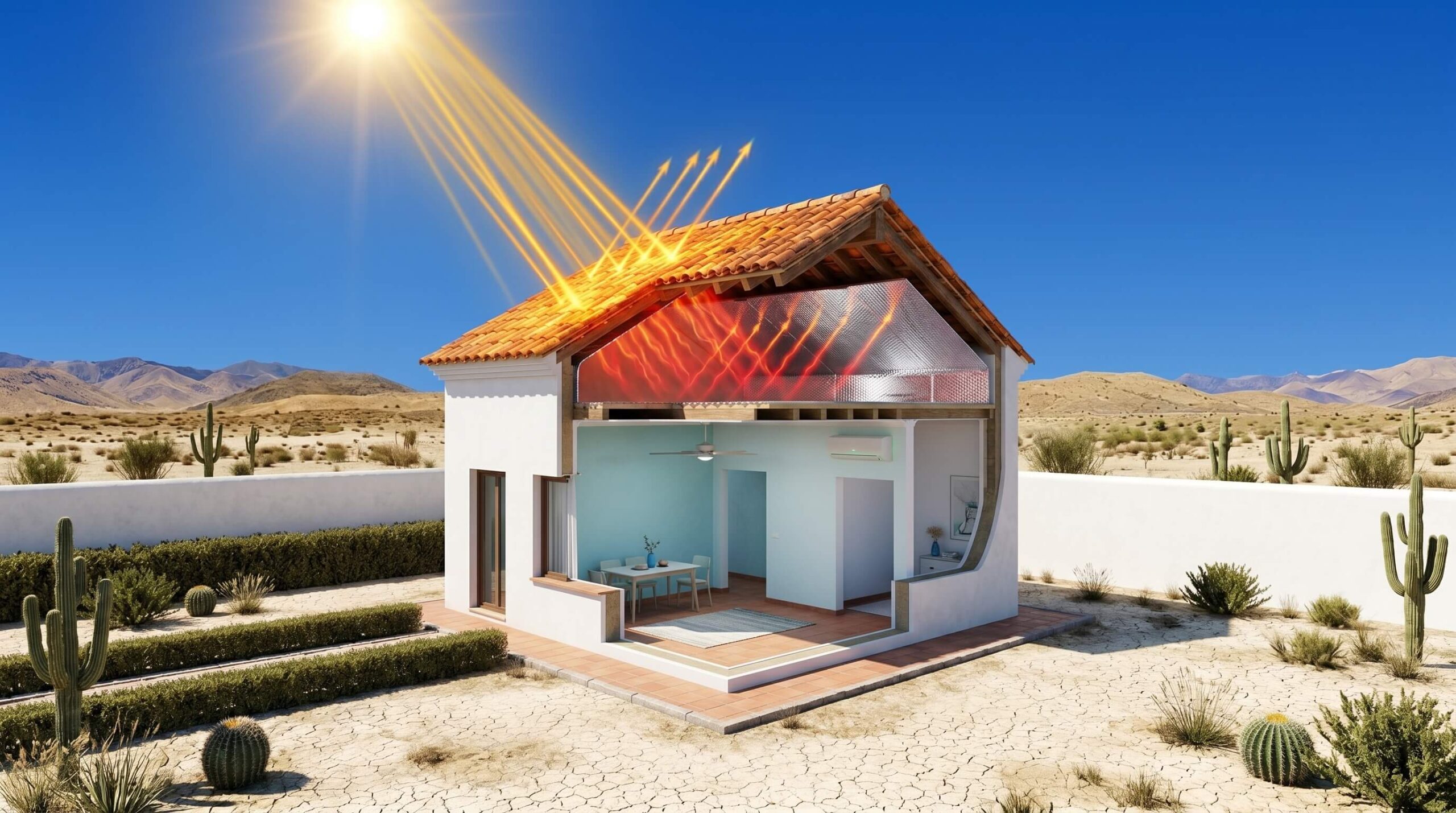
The physics of a Spanish summer are unforgiving. Solar irradiance in southern Spain and the Balearic Islands is among the highest in Europe. On a clear July day in Seville or Murcia, a roof surface can absorb enough solar energy to reach surface temperatures of 75°C to 80°C. That is not a figure from an engineering paper — it is something you can verify by placing your hand near a tiled roof on a hot afternoon, then immediately thinking better of it.
That stored heat does not stay on the roof. It radiates downward into the building. It conducts through the structure. It heats the interior air, the walls, the floors, and eventually every surface inside the home. By mid-afternoon, the thermal mass of the building itself has become a heat source, releasing stored energy into the living space hours after the sun has moved on.
Spanish architecture evolved intelligent passive responses to this problem over centuries. Deep-set windows, interior courtyards, thick stone walls, whitewashed exteriors to reflect solar radiation. These traditional techniques worked remarkably well in an era before cheap electricity made it possible to simply cool a poorly designed space by brute force.
Modern construction, unfortunately, often discarded those lessons. Flat-roofed residential developments, concrete block walls with minimal insulation, large glazed facades facing south and west — built during boom years when energy was cheap and climate projections seemed like someone else’s concern. Those buildings are now expensive to live in every summer, and their owners are looking for solutions.
The Air Conditioning Trap
Here is the fundamental problem with relying entirely on air conditioning in an under-insulated building. The AC unit cools the air inside. The roof and walls, with no effective thermal barrier, are simultaneously conducting and radiating heat inward. The unit is fighting a battle it cannot win efficiently — cooling air that is being reheated almost as fast as it chills it.
The result is an AC system running at near-maximum capacity for ten or twelve hours a day. Electricity consumption is enormous. The unit itself wears faster under this kind of continuous load — compressors that might last fifteen years in a well-insulated home can need replacement in seven or eight in a poorly insulated one. And despite all of this, the home may still feel uncomfortably warm in the rooms furthest from the unit, or in upper floors where heat accumulates.
Insulation breaks this cycle at the source. When a proper reflective barrier is installed at roof level and across external walls, the amount of radiant and conductive heat entering the building is dramatically reduced. The AC unit is no longer fighting a constant stream of incoming solar energy. It cools the space, the thermal envelope holds that coolness in, and the unit cycles off. Running time drops. Electricity consumption drops. Bills drop. And the unit lasts years longer.
The return on investment in Spain’s climate is not theoretical. It is fast and measurable. In a typical Spanish home running air conditioning through a four-month summer, a meaningful reduction in cooling load translates directly into hundreds of euros saved annually. The insulation pays for itself, then keeps saving money for the fifteen to twenty years of its working life.
Where the Heat Gets In
Understanding where to insulate requires understanding where heat enters the building in the first place.
The roof is the primary culprit. Flat or low-pitch roofs common across Spanish urban developments offer almost no natural shading and maximum surface area for solar absorption. Even pitched tile roofs, traditional as they are, can reach extreme temperatures on the tile undersurface during peak afternoon hours. Without a reflective barrier beneath the tiles, all of that energy radiates freely into the space below.
South and west-facing external walls are the second major heat gain route. South-facing walls receive intense direct sun through the middle of the day. West-facing walls, often overlooked, receive the most brutal exposure of all — direct afternoon sun at its hottest point, from around 3pm until sunset. A west-facing bedroom wall in Valencia in August is not a comfortable thing to sleep next to.
Thermal bridges — points where insulation is absent or interrupted, such as concrete columns, window lintels, and floor-ceiling junctions — allow heat to bypass insulation and conduct directly into the structure. Addressing these systematically, alongside the main roof and wall surfaces, is what separates a genuinely comfortable building from one that is merely better than it was.
The Right Products for the Mediterranean Climate
Alumix Insulation Global’s product range was developed with demanding climates in mind, and the Spanish summer represents exactly the kind of challenge these products are engineered to address.
For roof applications — whether a flat concrete roof terrace, a pitched tile roof, or an industrial unit with a metal deck — the Multi Layers TRP-FRNS is the flagship solution. This multi-layer reflective insulation system combines high-performance aluminium foil reflective surfaces with a fire-retardant core certified to UL94 standards. It blocks radiant heat transmission at roof level with exceptional efficiency while also providing acoustic absorption — relevant in urban Spanish environments where noise is as much a comfort concern as temperature. Its fire safety certification makes it suitable for both residential and commercial applications, including the kind of mixed-use developments common across Spanish cities.
For external wall applications, the Radiant Barrier Woven provides a robust, tear-resistant reflective barrier that reflects up to 95% of incoming radiant heat. It integrates cleanly into external wall build-ups as an underlay or cavity layer, and its woven substrate gives it the structural durability to handle the mechanical stresses of installation without tearing or deforming. For south and west-facing walls receiving daily punishment from direct Mediterranean sun, this is a practical and proven solution.
For targeted applications — a roof terrace ceiling, a top-floor flat with an exposed concrete soffit, a garage conversion being adapted for summer use — the Poly Care PC4G rigid 4mm double-sided gold foil panel offers 98% radiant heat reflection in a sheet format that is easy to cut and fix. At 120cm × 100cm per sheet, it covers large areas efficiently and is equally suited to new installations and retrofit projects where disruption needs to be minimised.
For properties where a comprehensive ceiling or loft-level barrier is the priority, the DUO X10 Ceiling — a dual-sided metalised foil insulation with air bubble core — provides excellent reflective performance above living areas, bouncing downward radiant heat back toward the roof and keeping ceilings noticeably cooler even during peak afternoon heat.
What a Well-Insulated Spanish Home Actually Feels Like
It is worth describing, because many Spanish homeowners have never experienced it and find the improvement hard to believe until they do.
A properly insulated home in southern Spain in July maintains a meaningful temperature differential between indoors and outdoors without the air conditioning running continuously. You close the shutters in the morning, the insulation holds the night coolness in through the morning hours, and by the time the afternoon heat peaks, the interior has risen only modestly. When the AC does run, it reaches target temperature quickly and cycles off. Evenings, when outdoor temperatures finally drop, allow natural ventilation to cool the building back down for the following day.
This is not science fiction. It is how well-built, well-insulated Spanish homes have always behaved — and it is fully achievable in the existing housing stock with the right insulation upgrades.
Compliance, Certification, and the Future of Spanish Buildings
Spain’s building energy efficiency regulations have tightened significantly in recent years, driven by EU directives pushing toward near-zero energy buildings across the bloc. New builds must meet increasingly stringent thermal performance requirements. But the more pressing challenge is the existing stock — the millions of homes and commercial buildings constructed before these standards existed, now requiring retrofit upgrades to remain economically viable to run and compliant with evolving energy labelling requirements.
Alumix Insulation Global products carry UL94, Green Tag, and TÜV certifications, reflecting 33 years of manufacturing to international export standards across more than 20 countries. For Spanish property owners navigating energy efficiency compliance — whether for a rental property requiring an updated energy certificate or a commercial building managing corporate sustainability commitments — certified insulation products with documented performance data are not a luxury. They are a requirement.
The Bottom Line
Spain’s summer is not going to get cooler. Energy prices are not going to get cheaper. And air conditioning, however essential it has become, is not a substitute for a building envelope that does its job.
The most cost-effective investment a Spanish homeowner or property manager can make right now is reducing the heat load their cooling system has to fight. Alumix Insulation Global’s reflective insulation range — the Multi Layers TRP-FRNS, Radiant Barrier Woven, Poly Care PC4G, and DUO X10 — provides that protection at roof and wall level, certified to international standards, and proven across climates that make a Spanish July look manageable.
Stop paying to cool a building that is undermining you. Insulate first. Then let the AC do the easy part.
Alumix Insulation Global — certified thermal insulation solutions for residential, commercial, and industrial applications worldwide. Learn more at alumixinsulationglobal.com
Leave a Reply